
Duplex Steel Flanges are high-performance forged piping components manufactured from duplex stainless steels that combine the properties of austenitic and ferritic stainless steel microstructures. This dual-phase structure provides a valuable combination of high mechanical strength, resistance to chloride-induced corrosion, good resistance to stress corrosion cracking, and useful weldability when appropriate fabrication procedures are followed.
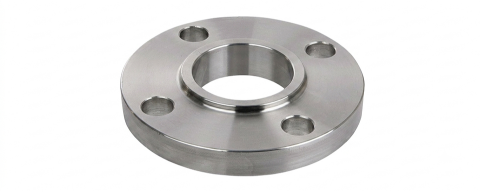
A Duplex Steel Flange is commonly specified for demanding piping systems in oil and gas, petrochemical, chemical processing, desalination, marine, pulp and paper, and offshore applications. Grades such as UNS S31803, S32205, S32750, and S32760 are selected according to the required balance of strength, corrosion resistance, temperature capability, and service environment.
For industrial procurement, an experienced Duplex Steel Flange Stockist in India can provide flanges in different duplex grades, pressure classes, sizes, facing configurations, and dimensional standards.
A Duplex Steel Flange is a forged flange manufactured from duplex stainless steel and used to connect pipes, valves, pumps, pressure vessels, heat exchangers, and other pressure-containing equipment.
Unlike conventional austenitic stainless steel, duplex stainless steel contains approximately balanced ferritic and austenitic phases. This microstructure provides higher yield strength than many common austenitic grades while retaining good resistance to a wide range of corrosive environments.
The selection of a Duplex Steel Flange should consider:
Different duplex grades are designed for different levels of corrosion resistance and mechanical performance.
Duplex 2205 is one of the most widely used duplex stainless steel grades. UNS S32205 is the commonly specified higher-nitrogen version of the 2205 composition, while UNS S31803 represents the original duplex 2205 designation.
Duplex 2205 provides:
Typical applications include:
Super Duplex 2507 contains higher chromium, molybdenum, and nitrogen levels than standard 2205. These alloying additions significantly improve resistance to pitting, crevice corrosion, and chloride-containing environments.
Super Duplex 2507 Flanges are commonly used in:
UNS S32760 is another super duplex grade designed for severe corrosion environments. It contains chromium, molybdenum, nitrogen, and tungsten additions that contribute to its high localized-corrosion resistance.
It is suitable for demanding applications involving:
The chemical composition of duplex stainless steel varies by grade. Chromium, molybdenum, nickel, and nitrogen are particularly important because they influence phase balance and corrosion resistance.
Typical composition ranges for commonly used grades are shown below.
| Element | Duplex 2205 UNS S32205 | Super Duplex 2507 UNS S32750 |
|---|---|---|
| Carbon | ≤ 0.030% | ≤ 0.030% |
| Chromium | 22.0–23.0% | 24.0–26.0% |
| Nickel | 4.5–6.5% | 6.0–8.0% |
| Molybdenum | 3.0–3.5% | 3.0–5.0% |
| Nitrogen | 0.14–0.20% | 0.24–0.32% |
| Manganese | ≤ 2.0% | ≤ 1.20% |
| Silicon | ≤ 1.0% | ≤ 0.80% |
| Iron | Balance | Balance |
Actual composition must be verified against the applicable ASTM/ASME specification and material certificate for the specific product.
Duplex stainless steels offer substantially higher yield strength than many conventional austenitic stainless steel grades.
Typical minimum mechanical requirements for commonly specified grades include:
| Property | Duplex 2205 UNS S32205 | Super Duplex 2507 UNS S32750 |
|---|---|---|
| Tensile Strength | Approx. 620 MPa minimum | Approx. 795 MPa minimum |
| Yield Strength | Approx. 450 MPa minimum | Approx. 550 MPa minimum |
| Elongation | Approx. 25% minimum | Approx. 15% minimum |
| Microstructure | Austenitic-Ferritic | Austenitic-Ferritic |
Exact mechanical requirements depend on product specification, material condition, flange class, and applicable standard.
The duplex microstructure gives these materials considerably higher yield strength than many conventional austenitic stainless steels.
This can allow engineers to achieve required mechanical performance with optimized section thicknesses, subject to applicable design calculations and code requirements.
Duplex stainless steels generally offer significantly better resistance to chloride stress corrosion cracking than conventional austenitic stainless steels such as 304 and 316.
This characteristic is particularly valuable in:
Chromium, molybdenum, and nitrogen contribute to localized corrosion resistance. Super duplex grades provide even higher resistance where severe chloride exposure is expected.
The dual-phase structure provides high yield strength and good tensile performance, making Duplex Steel Flanges suitable for demanding pressure-containing systems.
Duplex stainless steel can provide good resistance to many aqueous and chemical environments. However, actual compatibility must be established from the complete process chemistry and operating conditions.
Corrosion resistance is one of the primary reasons duplex stainless steels are selected.
The material's chromium content promotes formation of a passive oxide layer, while molybdenum and nitrogen improve resistance to localized corrosion. Nickel helps stabilize the austenitic phase and contributes to the desired duplex microstructure.
Duplex grades are particularly valuable where the system is exposed to:
Material selection should consider temperature because localized corrosion resistance and phase stability can change with service conditions.
Weld Neck Flanges are widely used in high-pressure and critical piping systems. Their tapered hub provides a gradual transition between the pipe and flange, helping distribute stresses around the welded connection.
They are frequently selected for:
Blind Flanges are solid flanges used to terminate piping systems or close equipment nozzles.
They are useful for:
Slip-On Flanges fit over the pipe and are welded around the outside and at the bore. They may be used where permitted by the piping design and applicable engineering specification.
Socket Weld Flanges are commonly used with smaller-diameter piping systems. The pipe fits into the flange socket before welding.
Threaded flanges provide a mechanical connection without a welded joint. Their application is limited by pressure, temperature, service conditions, and applicable design code.
Lap Joint Flanges are used with compatible stub ends and can be advantageous in systems requiring frequent disassembly.
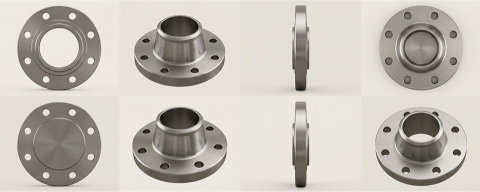
The flange facing determines how the gasket and mating flange form the sealing interface.
Common options include:
Raised Face is widely used for industrial piping and provides a defined gasket seating area.
Ring Type Joint flanges use a metallic ring gasket installed within a precision-machined groove. They are frequently selected for high-pressure applications where the piping specification requires an RTJ connection.
Duplex Steel Flanges can be manufactured according to recognized ASTM, ASME, EN, and other international standards.
| Standard | Application |
|---|---|
| ASTM A182 / ASME SA182 | Forged alloy and stainless steel flanges and fittings |
| ASME B16.5 | Pipe flanges and flanged fittings |
| ASME B16.47 | Large-diameter steel flanges |
| ASME B16.48 | Line blanks |
| EN 1092-1 | Flanges and dimensions |
| MSS SP-44 | Steel pipeline flanges |
The exact material and dimensional specification should be confirmed before procurement because different standards may have different requirements for dimensions, pressure ratings, testing, and material grades.
Duplex Steel Flanges are available in several ASME pressure classes.
Common classes include:
The pressure class does not represent one fixed allowable pressure at every temperature. Permissible pressure depends on the flange material, temperature, dimensional standard, and applicable pressure-temperature tables.
Duplex stainless steel is produced with carefully controlled chemical composition to achieve the required ferritic-austenitic phase balance.
The billet or suitable raw material is heated and forged into the required flange geometry. Forging parameters must be controlled to avoid undesirable metallurgical changes.
Solution annealing is particularly important for duplex stainless steels. The material is heated to an appropriate temperature and rapidly cooled to establish the required microstructure and restore corrosion resistance.
After heat treatment, the flange is machined to the required dimensional tolerances, bore, bolt holes, hub, and sealing face.
Finished flanges undergo dimensional, visual, chemical, mechanical, and other specified inspections before release.
Solution annealing is a critical manufacturing step for duplex stainless steel.
The objective is to establish an appropriate balance between ferrite and austenite while avoiding harmful intermetallic phases such as sigma phase.
Improper heat treatment or prolonged exposure to certain temperature ranges can reduce toughness and corrosion resistance.
For this reason, duplex flange manufacturing requires controlled:
Duplex stainless steels require more controlled welding than many conventional austenitic stainless steels.
Welding procedures should maintain an appropriate ferrite-austenite balance in the heat-affected and fusion zones.
Important considerations include:
The objective is to prevent excessive ferrite, excessive austenite, or harmful intermetallic phase formation.
For critical applications, weld qualification and inspection should follow the relevant code and project specification.
Duplex flanges are extensively considered for oil and gas systems where chloride exposure, high mechanical loads, and demanding process conditions occur.
Applications include:
Petrochemical facilities use duplex materials in selected process systems where a combination of corrosion resistance and high strength is required.
Desalination equipment is exposed to high-chloride seawater and brine. Duplex and super duplex stainless steels are commonly selected for suitable seawater-service components.
Duplex flanges can be used in chemical processing systems where the material provides the required resistance to the specific process medium.
Marine equipment and piping can experience chloride-rich environments. Duplex stainless steel can provide improved resistance to localized corrosion and stress corrosion cracking compared with conventional stainless grades.
Certain process streams in pulp and paper facilities can create aggressive chemical environments. Duplex stainless steels can be selected for compatible process conditions.
Duplex Steel Flanges are used across industries where mechanical strength and corrosion resistance must be considered together.
Duplex stainless steel is not simply a higher-grade replacement for 316 stainless steel. The appropriate choice depends on the service environment and engineering requirements.
| Property | Duplex Stainless Steel | 316 Stainless Steel |
|---|---|---|
| Microstructure | Austenitic-Ferritic | Austenitic |
| Yield Strength | Higher | Lower |
| Chloride SCC Resistance | Generally superior | More susceptible under certain conditions |
| Pitting Resistance | High | Good |
| Weldability | Requires tighter control | Generally easier |
| Thermal Expansion | Lower | Higher |
| Typical Use | Severe chloride/high-strength service | General corrosion-resistant service |
Duplex grades can be particularly attractive when high strength and chloride resistance are required simultaneously.
Super duplex grades contain higher alloying levels and provide greater resistance to localized corrosion than standard duplex grades.
| Feature | Duplex 2205 | Super Duplex 2507 |
|---|---|---|
| Chromium | Approx. 22% | Approx. 25% |
| Molybdenum | Approx. 3% | Approx. 4% |
| Nitrogen | Approx. 0.15–0.20% | Approx. 0.24–0.32% |
| Strength | High | Very high |
| Pitting Resistance | Excellent | Exceptional |
| Typical Environment | Chloride/process systems | Severe chloride/seawater service |
The more highly alloyed super duplex grades are often selected when the corrosion severity exceeds the practical capability of standard duplex 2205.
Quality inspection is essential for pressure-containing duplex components.
Depending on project requirements, inspection may include:
Ferrite measurement can be particularly relevant for duplex stainless steel because excessive ferrite or austenite imbalance can influence mechanical and corrosion performance.
A professional Duplex Steel Flange Supplier in India should provide traceable documentation according to the purchase order and applicable material standard.
Documentation may include:
A reliable Duplex Steel Flange Stockist in India can help industrial buyers source standard and project-specific duplex flanges for maintenance, replacement, fabrication, and new construction.
Available configurations may include:
Stock availability, grade range, dimensions, and certification should be confirmed before purchase.
| Parameter | Details |
|---|---|
| Product | Duplex Steel Flange |
| Material Type | Duplex Stainless Steel |
| Microstructure | Austenitic-Ferritic |
| Common Grades | S31803, S32205, S32750, S32760 |
| Manufacturing | Forged / Machined |
| Common Material Standard | ASTM A182 / ASME SA182 |
| Flange Standard | ASME B16.5 |
| Large Diameter | ASME B16.47 |
| Pressure Classes | 150, 300, 600, 900, 1500, 2500 |
| Common Facings | RF, FF, RTJ |
| Main Advantages | High strength and corrosion resistance |
| Key Corrosion Benefit | Strong resistance to chloride SCC and localized corrosion |
| Major Applications | Oil & Gas, Offshore, Chemical, Marine, Desalination |
| Important Manufacturing Control | Solution annealing and phase balance |
| Typical Inspection | PMI, NDT, ferrite testing, mechanical testing |
For an accurate quotation, provide the duplex grade, flange type, nominal size, pressure class, facing, bore or pipe schedule, quantity, applicable standard, inspection requirements, certification requirements, and delivery location.
An established Duplex Steel Flange Stockist in India can support standard and urgent requirements from available inventory, while an experienced Duplex Steel Flange Supplier in India can coordinate project-specific manufacturing, heat treatment, inspection, documentation, and export delivery.
Share your specification and get factory rates within 2 business hours.
Call +91 9167785999